What Is SaaS SEO?
The Complete Beginner's Guide (2026)
Everything your SaaS company needs to rank on Google, show up in AI search, and turn organic traffic into trial signups — without wasting another dollar on tactics that don't work.
Let's be honest. If you're building or marketing a SaaS product in 2026 and SEO still feels like a mystery — you're probably watching competitors quietly pull ahead in search results while you're burning money on paid ads that stop the moment your credit card does.
That's the pain SaaS SEO is built to solve. And this guide? It's not going to be another surface-level "just write good content!" post. We're going to go deep — covering what SaaS SEO actually is, why it's fundamentally different from regular SEO, how the strategy works, what pages you need, and how AI search changes the game entirely in 2026.
Whether you're a founder doing SEO yourself, a marketer trying to build an organic growth engine, or someone shopping for a SaaS SEO agency — this is your starting point.
📋 What's In This Guide
- What Is SaaS SEO?
- SaaS SEO vs. Regular SEO — The Real Differences
- Why SaaS SEO Is Your Most Important Growth Channel
- SaaS Keyword Strategy: How to Find the Right Keywords
- The SaaS SEO Page Architecture You Need
- SaaS Content Strategy: TOFU, MOFU, BOFU
- Technical SEO for SaaS Products
- SaaS SEO in the Age of AI Search (AEO & GEO)
- SaaS Link Building: What Actually Works
- How to Measure SaaS SEO Success
- Frequently Asked Questions
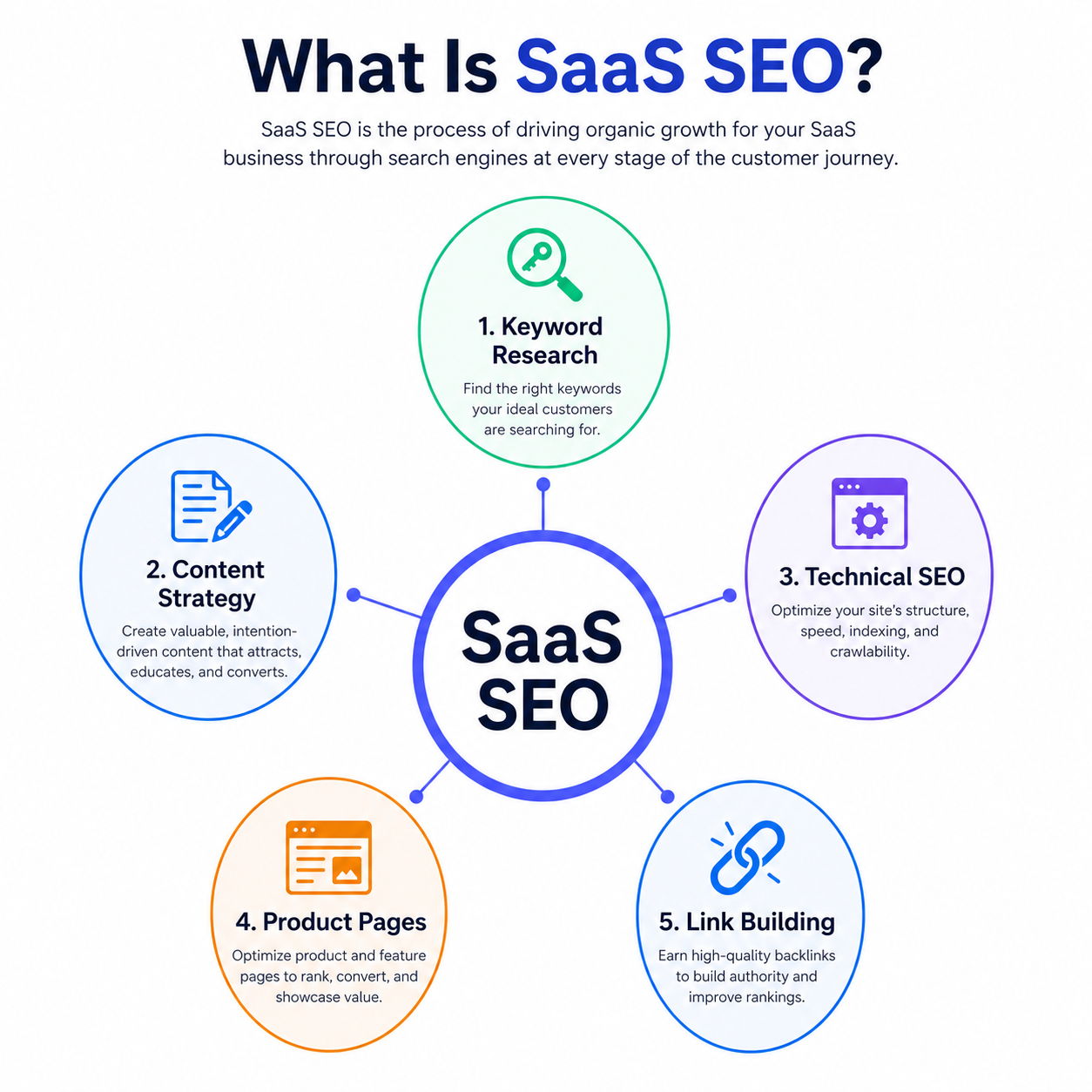
What Is SaaS SEO?
SaaS SEO is a search engine optimization strategy specifically designed for software-as-a-service companies. It's not just about getting traffic — it's about getting the right traffic: people who are actively looking for a solution like yours, at the exact stage where they're ready to try, compare, or buy.
Think about how your ideal customer searches. They don't type "best SaaS company." They type things like:
- "project management tool for remote teams"
- "HubSpot alternative for small business"
- "how to automate client onboarding"
- "best CRM for B2B startups 2026"
SaaS SEO is the art and science of showing up for every one of those searches — and converting that click into a free trial, demo, or signup. Our dedicated SaaS SEO services are built around exactly this approach.
SaaS SEO vs. Regular SEO — The Real Differences
Here's something most "intro to SEO" guides get wrong: they treat all SEO the same. SaaS SEO is a completely different discipline — same tools, entirely different strategy.
A local bakery and a SaaS HR platform are both doing "SEO." But almost nothing about their approach should look alike. Here's why:
| Dimension | Regular / Local SEO | SaaS SEO |
|---|---|---|
| Primary Goal | Drive foot traffic, calls, local leads | Drive signups, demos, free trials |
| Keyword Focus | Location-based, service terms | Problem-based, pain-point, comparison terms |
| Content Types | Service pages, reviews, GMB | Feature pages, alternatives, integrations, use cases |
| Conversion Path | Phone call or walk-in | Free trial, demo booking, freemium signup |
| Sales Cycle | Short (same day) | Long (weeks to months, multi-touchpoint) |
| Topical Depth | Moderate | Very deep — covers entire problem space |
| AI Search Impact | Moderate | Critical — buyers compare tools via AI assistants |
| Programmatic SEO | Rarely needed | Often essential (integrations, use cases, regions) |
The critical insight is this: SaaS buyers search by their problem. They don't know your product name — they know their pain. Your entire SEO strategy must be built to intercept that pain at every stage. This is why our B2B SEO approach puts problem-mapping at the center of every strategy.
"The best SaaS SEO isn't about rankings. It's about owning the entire problem space your product solves — so that no matter how or where your buyer searches, your brand is there."
— RankSenseAI Strategy TeamWhy SaaS SEO Is Your Most Important Growth Channel
Paid ads work — until they don't. The moment your budget drops, your traffic disappears with it. And in 2026, with rising CPC costs in competitive SaaS verticals, the math is getting harder to justify.
SEO compounds. Every piece of content you rank, every backlink you earn, every page that climbs to page one — it keeps working for you 24/7, long after the initial investment. Here's what that means for your business in real numbers:
Lower CAC
Organic traffic delivers customers at 3–6x lower Customer Acquisition Cost than paid channels once SEO reaches maturity — typically 6–12 months in.
Compounding Returns
Unlike paid ads that stop the moment your budget does, SEO builds a permanent asset. A top-ranking page can drive revenue for years with minimal maintenance.
AI Search Visibility
In 2026, buyers use ChatGPT, Perplexity, and Gemini to compare tools. Strong SEO authority directly feeds AI citation and recommendation likelihood.
Pipeline on Autopilot
Top-funnel SEO content warms buyers before they ever speak to sales — shortening deal cycles and improving close rates.
Competitive Moat
Domain authority and topical coverage take years to build. Once you're there, it becomes extremely difficult for competitors to dislodge you.
Reduces Churn Indirectly
Educational SEO content helps users get more value from your product — reducing support load and increasing retention.
SaaS Keyword Strategy: How to Find the Right Keywords
This is where most SaaS companies go wrong. They focus on high-volume vanity keywords that their domain authority can't compete for yet, while ignoring the high-intent, lower-competition terms that their ideal buyers are actually using.
SaaS keyword strategy is built around four core keyword categories:
1. Problem-Aware Keywords
These are the searches people make when they have a problem but don't know what the solution looks like yet. For a project management SaaS: "why is my team missing deadlines," "how to improve team productivity," "remote team communication problems."
These are TOFU (Top of Funnel) keywords. High volume, low conversion intent — but excellent for building brand awareness and bringing buyers into your ecosystem early.
2. Solution-Aware Keywords
Now the buyer knows they need a tool. They're searching "project management software for remote teams," "best team collaboration tools," "task management app." These are MOFU (Middle of Funnel) keywords — high relevance, competitive, but worth fighting for with strong content.
3. Product-Aware / Comparison Keywords
This is the money. Buyers searching "Asana vs Monday," "[Your Tool] alternatives," or "best Trello replacement" are actively comparing and ready to decide. These BOFU (Bottom of Funnel) keywords convert at dramatically higher rates — and they're often underserved by competitors.
4. Integration & Use-Case Keywords
Programmatic goldmines: "[Your Tool] + Slack integration," "[Your Tool] for healthcare," "[Your Tool] for agencies." These are long-tail, high-intent, and scale beautifully with programmatic SEO. A single tool with 50 integrations can generate 50 high-intent landing pages.
The SaaS SEO Page Architecture You Need
Keywords don't live in a vacuum — they live in pages. And the secret to scaling SaaS SEO is building a systematic page architecture that covers every stage of the buyer journey.
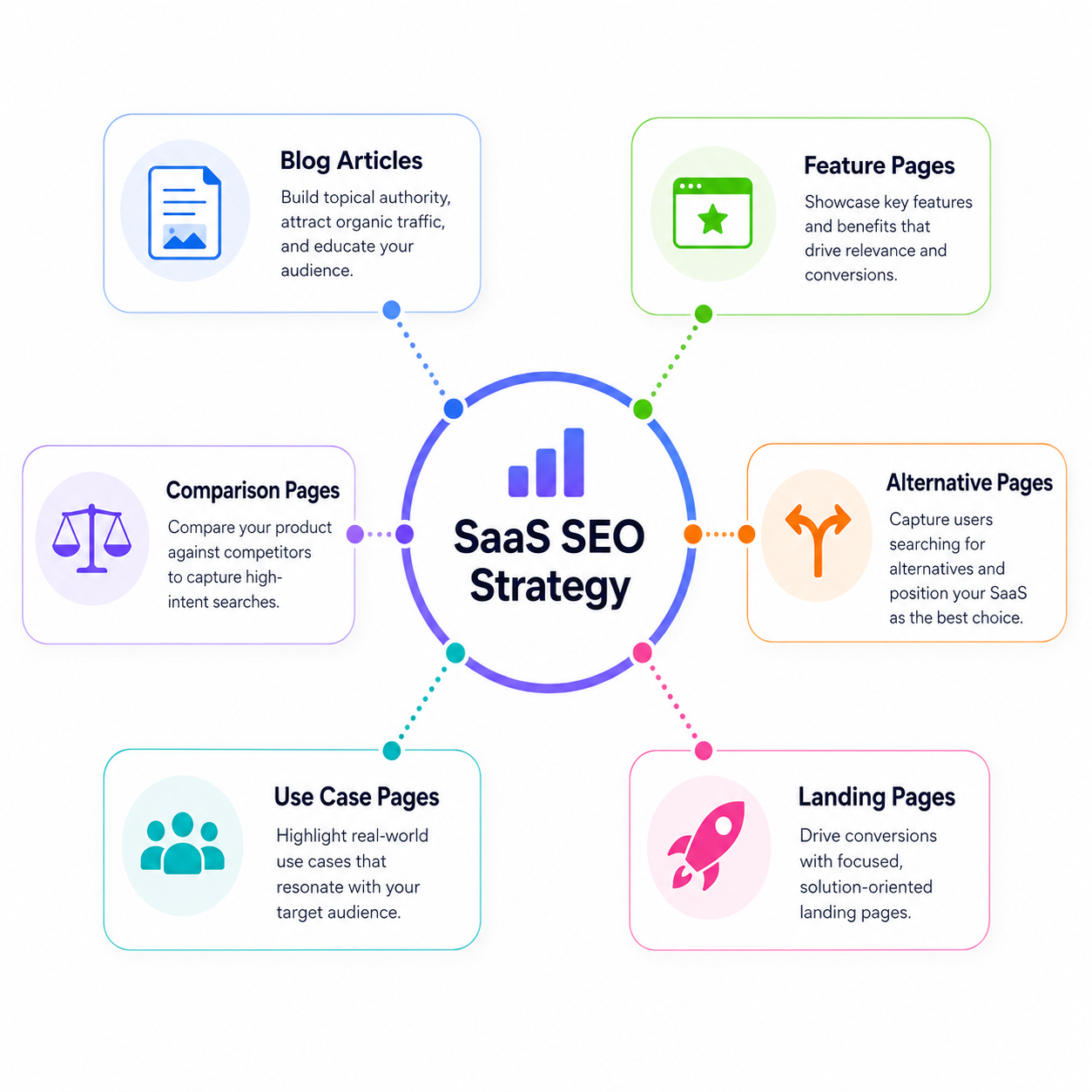
Here's the page architecture that the fastest-growing SaaS companies use:
Homepage (Brand Authority)
Your homepage should rank for your brand name and your primary category keyword (e.g., "project management software"). It's the anchor for all domain authority. Optimise the title tag, H1, page speed, and Core Web Vitals rigorously.
Feature Landing Pages
One dedicated page per core feature. If your tool has time tracking, reporting, and automation — each gets its own SEO-optimized landing page targeting the specific feature keyword. These pages drive the highest-quality, most purchase-ready traffic.
Comparison Pages (vs. Competitor)
"[Your Tool] vs [Competitor]" pages are among the highest-converting pages in SaaS SEO. Buyers searching these terms are actively deciding — and if you don't control that narrative, your competitor will. Build fair, thorough comparisons with real data. See how we approach SaaS competitor targeting.
Alternative Pages
"Best [Competitor] alternatives" pages capture buyers who are unhappy with a competitor and looking to switch. These are mid-to-high intent and often the gateway for your most loyal future customers.
Integration Pages
Each integration your tool supports deserves a dedicated landing page: "[Your Tool] + Zapier," "[Your Tool] + Salesforce," etc. These pages rank for high-intent buyers who already use those tools and want a seamless workflow.
Use Case & Industry Pages
"Project management for marketing agencies," "task tracking for software teams" — these pages speak directly to specific verticals and dramatically improve conversion because the messaging matches the buyer's context precisely.
Blog / Knowledge Hub
Your TOFU and MOFU content engine. Educational articles that solve your buyer's problems, build topical authority, earn backlinks, and drive the kind of compounding traffic that powers sustainable SaaS growth. Our SEO content writing service is purpose-built for this.
SaaS Content Strategy: TOFU, MOFU, BOFU
Content is the fuel of SaaS SEO. But not all content is created equal — and publishing blog posts randomly without a funnel strategy is one of the most common ways SaaS companies waste their content budget.
Every piece of content you create should have a defined funnel stage, a target keyword cluster, and a conversion goal. Here's the framework:
| Funnel Stage | Buyer State | Content Types | Conversion Goal |
|---|---|---|---|
| TOFU Top of Funnel |
Problem-aware, not solution-aware | How-to guides, definitional posts, industry statistics, trend reports | Email capture, newsletter signup, brand recall |
| MOFU Middle of Funnel |
Solution-aware, evaluating options | Comparison guides, best-of lists, templates, case studies | Free trial, freemium signup, demo request |
| BOFU Bottom of Funnel |
Product-aware, ready to decide | vs. pages, alternative pages, pricing comparisons, ROI calculators | Direct signup, paid plan conversion, sales call |
One thing most SaaS content strategies miss: content decay. A blog post that ranked #2 two years ago may have slipped to #8 today without you noticing. Regular SEO audits catch these declines before they become crises — and refreshing a decayed piece of content is often faster than creating something new.
Technical SEO for SaaS Products
Great content on a technically broken website doesn't rank. Technical SEO is the foundation everything else sits on — and for SaaS products, there are some very specific technical challenges that don't exist for normal websites.
Core Technical SEO Priorities for SaaS
- Crawlability & Indexation: Ensure Google can crawl all your key pages. SaaS apps often put important feature content behind login walls — move it to public-facing SEO pages.
- Core Web Vitals: Page speed, interactivity, and layout stability directly impact rankings and trial conversion. A slow signup page loses you customers before they even try your product.
- Site Architecture: Logical URL structure, clear silo architecture, and proper canonicalization prevent duplicate content issues — especially important for programmatic SEO at scale.
- Schema Markup: Implement SoftwareApplication, FAQPage, HowTo, and Article schemas across relevant pages to improve rich result eligibility and AI search citation quality.
- Internal Linking: A strong internal link structure distributes page authority and helps Google understand topical relationships across your content. Every blog post should link to a relevant feature page.
- Mobile Optimization: SaaS buyers often research on mobile before deciding on desktop. Mobile-first is not optional.
- HTTPS & Security Signals: SaaS buyers are giving you their data. SSL, secure forms, and trust signals directly impact conversion and Google's site quality assessment.
SaaS SEO in the Age of AI Search (AEO & GEO)
This is the part of SaaS SEO that most agencies aren't talking about yet — and it's the most important shift happening in 2026.
Your SaaS buyers are increasingly using ChatGPT, Perplexity, Google AI Overviews, Gemini, and Microsoft Copilot to research, compare, and shortlist tools. "What's the best project management software for agencies?" used to be a Google search. Today, it's just as likely to be a ChatGPT prompt.
If your SaaS brand isn't being recommended in those AI answers — you're already losing deals you don't even know about.
What Is AEO (Answer Engine Optimization)?
AEO is the practice of structuring your content so it gets directly quoted, cited, or summarized by AI assistants. It involves writing in clear, direct answer formats, using schema markup, and building the kind of EEAT signals (expertise, authoritativeness, trustworthiness) that AI models prioritize when selecting sources.
What Is GEO (Generative Engine Optimization)?
GEO goes a step further — it's about earning your brand mentions within AI-generated responses, not just citations. If ChatGPT recommends three project management tools and yours isn't one of them, that's a GEO problem. Building brand authority through high-quality backlinks, third-party mentions, and authoritative content is what makes AI engines trust you enough to recommend you.
Conversational Content
Write in natural Q&A format. AI models are trained on human conversation — direct-answer writing gets pulled into responses more reliably than dense paragraphs.
Schema & Structure
FAQPage, HowTo, and SoftwareApplication schemas make your content machine-readable for AI crawlers including GPTBot, ClaudeBot, and PerplexityBot.
Third-Party Mentions
AI models trust what others say about you more than what you say about yourself. PR, review sites (G2, Capterra), and editorial mentions build GEO authority.
SaaS Link Building: What Actually Works
Backlinks remain one of Google's most powerful ranking signals — and for SaaS, they also feed directly into AI trust signals. But link building in 2026 is not about buying links or spamming guest posts. The tactics that work for SaaS are specific, scalable, and aligned with genuine value creation.
SaaS Link Building Strategies That Work
Product-Led PR & Data Studies
Publish original research or industry data reports. Journalists, bloggers, and analysts cite data-backed studies — earning you high-authority editorial links. One good study can generate 30–100+ backlinks organically.
Integration Partnership Links
Every tool you integrate with is a link building opportunity. Most integration marketplaces and partner pages link back to their integration partners — and these links carry high topical relevance.
G2, Capterra & Review Platforms
Beyond the direct link value, these platforms are cited heavily in AI responses. Your presence and rating on SaaS review platforms directly influence your GEO visibility.
Guest Content on Industry Publications
Strategic guest articles on SaaS-adjacent publications (not link farms) build authority and referral traffic. Focus on publications your target buyers actually read.
How to Measure SaaS SEO Success
This is where a lot of SaaS teams (and agencies) get it wrong. They report on rankings and traffic. Those are leading indicators — useful, but not the goal.
SaaS SEO success is measured by its impact on your business metrics. Here's the measurement framework we use with every client:
| Metric Layer | What to Track | Why It Matters |
|---|---|---|
| Visibility | Keyword rankings, Search Console impressions, AI citation frequency | Leading indicator — tells you if SEO is working before traffic materializes |
| Traffic | Organic sessions, non-branded clicks, new users from organic | Validates visibility is translating to actual visitors |
| Engagement | Time on page, scroll depth, bounce rate, pages per session | Tells you if content quality and UX are matching search intent |
| Conversion | Organic trial signups, demo requests, email captures | The real ROI — organic traffic turning into pipeline |
| Revenue | Organic-influenced MRR, CAC by channel, LTV from organic customers | The ultimate measure — organic SEO's contribution to revenue growth |
The EEAT Factor: Why Google Trusts Some SaaS Blogs Over Others
Google's quality guidelines are built around a concept called EEAT: Experience, Expertise, Authoritativeness, and Trustworthiness. For SaaS brands, this is the difference between content that ranks and content that sits on page 7 forever.
- Experience: Your content should demonstrate real first-hand experience with the problems your product solves. Case studies, product screenshots, real customer outcomes — these signal lived experience.
- Expertise: Named authors with credentials, detailed technical breakdowns, and depth of knowledge that goes beyond surface-level definitions. If your blog sounds like it was written by a generalist intern, Google's quality raters will notice.
- Authoritativeness: Third-party signals — backlinks, brand mentions, press coverage, review platform presence, and being cited by other authoritative sources in your space.
- Trustworthiness: Privacy policy, terms of service, clear contact information, transparent pricing, customer testimonials, and security certifications. This matters especially for SaaS where users are sharing sensitive data.
At RankSenseAI, EEAT is built into every piece of content we produce. Our SEO content writing service works with your team's subject matter experts to ensure content reflects genuine expertise — not AI-generated filler. And our growth SEO service builds the off-site authority signals that amplify it.
Frequently Asked Questions About SaaS SEO

Author: Irfan Dar
Irfan Dar is an SEO professional with 4+ years of experience in SEO, performance marketing, and digital analytics. He specializes in technical SEO, content strategy, on-page optimization, keyword research, AEO (Answer Engine Optimization), and GEO (Generative Engine Optimization). At RankSenseAI, Irfan focuses on helping businesses improve their visibility across traditional search engines and emerging AI search platforms. His work covers technical SEO, content optimization, AI search visibility, structured data, entity optimization, and strategies designed to help brands get discovered across search experiences such as Google AI Overviews, ChatGPT, and other AI-powered platforms. He also works with tools and platforms including Google Search Console, GA4, Google Tag Manager, SEMrush, Screaming Frog, Google Ads, Meta Ads, and Looker Studio. Irfan believes effective SEO is not just about rankings. It is about creating useful, technically sound content and building the signals that help search engines and AI systems understand, trust, and surface a brand.