📅 Published: June 14, 2026 | ⏱️ 14 min read | ✍️ RankSenseAI Team
B2B buyers don't make impulse decisions. They research, compare, loop in colleagues, and increasingly — ask AI tools to help them shortlist vendors before a single sales call happens. If your brand isn't visible at every one of those touchpoints, you're not in the running.
This is our complete B2B SEO guide for 2026 — covering strategy, content that builds real authority, technical foundations, and AI search visibility. If you're a SaaS company specifically, you may also want our SaaS SEO Complete Guide and SaaS SEO vs. B2B SEO: Key Differences. For services, see B2B SEO Services.
📋 Quick Navigation
What Is B2B SEO?
B2B SEO is the practice of optimizing a business's website and content to attract and convert other businesses — typically involving longer sales cycles, multiple stakeholders, and content built around expertise, trust, and proof rather than impulse appeal.
Unlike B2C, where a single person often makes a quick purchase decision, B2B SEO needs to support an entire committee of people — each with different concerns — across a research process that can stretch for months.
Understanding the B2B Buying Committee
A typical B2B purchase involves several roles, each searching for different things:
| Role | What They Search For |
|---|---|
| End User / Practitioner | "How to solve [specific problem]," tutorials, how-tos |
| Manager / Decision Influencer | Comparisons, "best [category] for [industry]," frameworks |
| Executive / Budget Holder | ROI data, case studies, "[category] for enterprise" |
A complete B2B content strategy needs material for all three — which is why a single "blog" without strategic structure rarely performs. This is the core of what our content strategy services are designed to fix.
B2B Content Pillars That Build Authority
In our experience, B2B content that genuinely builds authority falls into four pillars:
- Original frameworks & methodologies — your unique point of view on how to solve a problem, demonstrated through real examples
- Case studies with real numbers — specificity builds trust faster than any amount of generic copy
- Industry/role-specific guides — "[Solution] for [Industry]" content that speaks directly to a niche
- Comparison & evaluation content — helping buyers compare options (including honest comparisons, not just "why we're best")
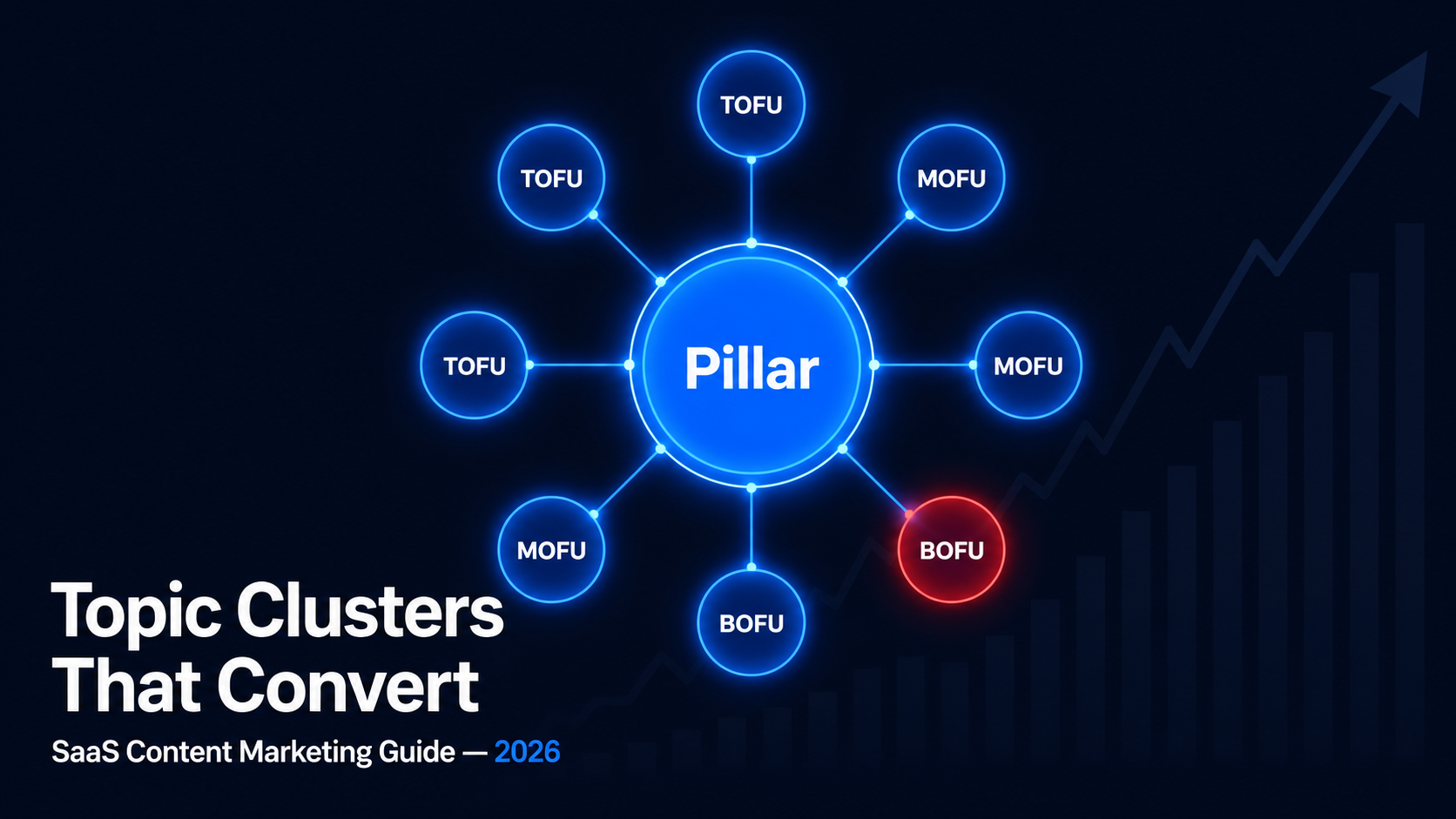
This mirrors the funnel-based approach we use for SaaS SEO — but with more emphasis on proof and methodology over product features.
B2B Keyword & Topic Strategy
B2B keyword research should map directly to the buying committee roles above. A practical approach:
- Problem-based keywords: "how to [solve specific operational problem]"
- Solution-category keywords: "[type of service/solution] for [industry]"
- Evaluation keywords: "[category] vendors," "[category] checklist," "how to choose [category]"
- Branded + competitor keywords: for businesses already evaluating you or competitors
Group these into topic clusters around your core service areas — for example, around SEO consulting, AI SEO, and enterprise SEO as natural examples of how service-line clustering works.
Technical SEO & EEAT for B2B Sites
B2B buyers — and AI engines evaluating your content — are both looking for trust signals. The technical and EEAT foundation matters as much as the content itself:
- Clean crawlability and indexation (see our crawlability guide)
- Author bios with real credentials on every article — critical for EEAT
- Article, Organization, and BreadcrumbList schema implemented site-wide
- Fast, stable pages (Core Web Vitals) — especially on case study and pricing pages
Our Technical SEO Guide 2026 covers this foundation in full, and our SEO Audit Services assess it directly.
AI Search Visibility for B2B Brands
B2B buyers are increasingly asking AI tools things like "what's the best [category] consultant for [industry]?" or "how do companies typically approach [problem]?" — and getting answers that name specific vendors or frameworks.
To improve your odds of being part of that answer:
- Publish content with a clearly defined, named methodology or framework (easier for AI to attribute to your brand)
- Structure content with answer-first sections and FAQ schema (see our AEO guide)
- Build genuine third-party presence — press mentions, guest content, directory listings
This is the GEO layer described in full in our Complete Guide to GEO/AEO 2026 — and it's baked into our AI SEO Services.
Measuring B2B SEO Success
B2B SEO success isn't just rankings or traffic — it's pipeline influence. Track:
- Organic leads / contact form submissions from non-branded search
- Rankings for evaluation and comparison keywords — these tend to convert highest
- Content engagement by funnel stage — are BOFU pages getting traffic, not just TOFU?
- AI citation presence for category and "best of" queries
If your current reporting doesn't connect to any of these, it's worth a second look — see our SEO agency red flags guide for what good reporting should look like.
Ready to Build a B2B SEO Strategy That Drives Pipeline?
Get a free audit covering technical health, content authority gaps, and AI search visibility — built for B2B buying cycles.
Explore B2B SEO Services →Frequently Asked Questions
What is B2B SEO?
B2B SEO is the practice of optimizing a business's website and content to attract and convert other businesses, typically involving longer sales cycles, multiple stakeholders, and content built around expertise, trust, and proof.
How is B2B SEO different from B2C SEO?
B2B SEO must support a buying committee of multiple roles across a long research process, while B2C SEO typically targets a single buyer making a faster decision driven by price, reviews, and convenience.
What type of content works best for B2B SEO?
Original frameworks, case studies with specific numbers, industry-specific guides, and honest comparison content tend to perform best because they build the trust and authority B2B buyers and AI engines both look for.
Should B2B companies invest in AI search optimization?
Yes. B2B buyers increasingly use AI tools to shortlist vendors and frameworks before contacting sales, making AI citation presence an important part of the buyer journey.
🎯 Key Takeaways
- B2B SEO must serve an entire buying committee, not a single buyer persona.
- Authority-building content (frameworks, case studies, comparisons) outperforms generic blog content.
- Technical SEO and EEAT signals (author bios, schema) are critical trust factors for both buyers and AI engines.
- AI search visibility is increasingly part of vendor shortlisting — don't ignore GEO/AEO.
- Measure pipeline influence, not just rankings and traffic.
RankSenseAI Team
We help SaaS, B2B, and modern brands stay visible across Google and emerging AI-powered search ecosystems — combining technical SEO, content strategy, and AI search optimization for organic growth that lasts.

Author: Irfan Dar
Irfan Dar is an SEO professional with 4+ years of experience in SEO, performance marketing, and digital analytics. He specializes in technical SEO, content strategy, on-page optimization, keyword research, AEO (Answer Engine Optimization), and GEO (Generative Engine Optimization). At RankSenseAI, Irfan focuses on helping businesses improve their visibility across traditional search engines and emerging AI search platforms. His work covers technical SEO, content optimization, AI search visibility, structured data, entity optimization, and strategies designed to help brands get discovered across search experiences such as Google AI Overviews, ChatGPT, and other AI-powered platforms. He also works with tools and platforms including Google Search Console, GA4, Google Tag Manager, SEMrush, Screaming Frog, Google Ads, Meta Ads, and Looker Studio. Irfan believes effective SEO is not just about rankings. It is about creating useful, technically sound content and building the signals that help search engines and AI systems understand, trust, and surface a brand.