Google I/O 2026 & AI Mode Going Default: What It Means for You
If you make a living from search traffic, the keynote on May 19 probably landed somewhere between fascinating and terrifying. We watched it live, and honestly, the feeling in our team chat was a mix of "this is incredible" and "okay, everything just changed." If you felt that too, you are not overreacting. You are paying attention.
At Google I/O 2026, Google made AI Mode the default search experience worldwide, rebuilt the search box for the first time in 25 years, and introduced background agents that search for you around the clock. This is the biggest shift to Search in a generation. Here is exactly what was announced, what it means for your traffic, and the honest plan we would give any founder right now.
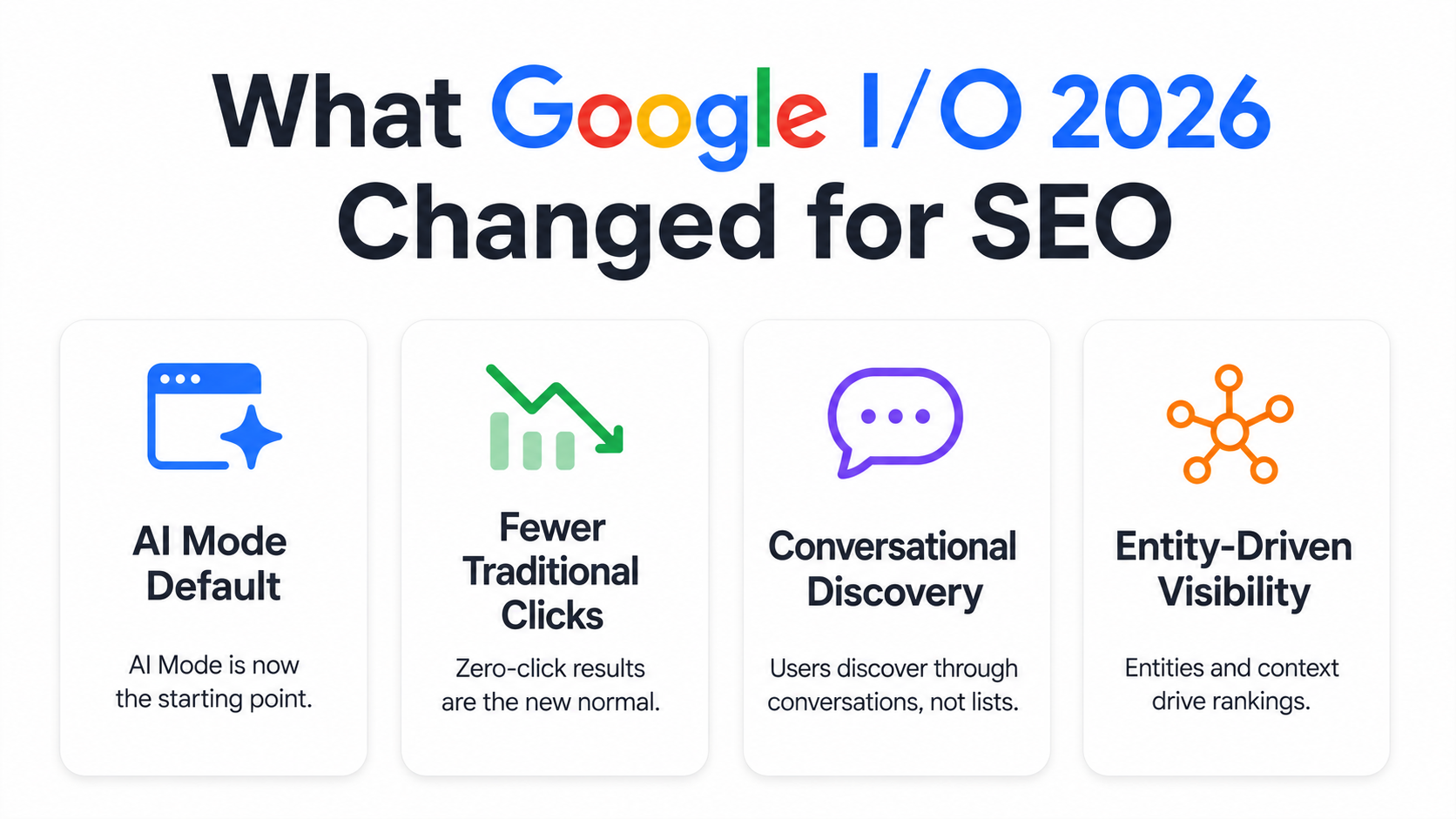
Google I/O 2026: the moment Search officially became AI-first for everyone.
What Google Actually Announced
Google announced five major Search changes at I/O 2026 on May 19: AI Mode powered by a new default model, a reimagined AI search box, persistent background agents, expanded agentic checkout, and a wider rollout of personal context. Together they reframe Search from a list of links into an assistant that researches, monitors, and acts on your behalf.
Straight from Google's own keynote blog, the headline was clear. Google confirmed it is upgrading Search with Gemini 3.5 Flash as the new default model in AI Mode for everyone globally, alongside the biggest upgrade to the search box in over 25 years. The company also noted AI Mode passed a billion monthly users just one year after launch, with queries more than doubling every quarter.
- New default AI model: Gemini 3.5 Flash now powers AI Mode globally.
- Reimagined search box: it expands as you type, built for longer, conversational queries.
- Search agents: "information agents" run 24/7 in the background and notify you, no fresh search needed.
- Agentic checkout: Universal Cart lets Google complete purchases for you, expanding to more regions.
- Personal context: personalization expands to nearly 200 countries.
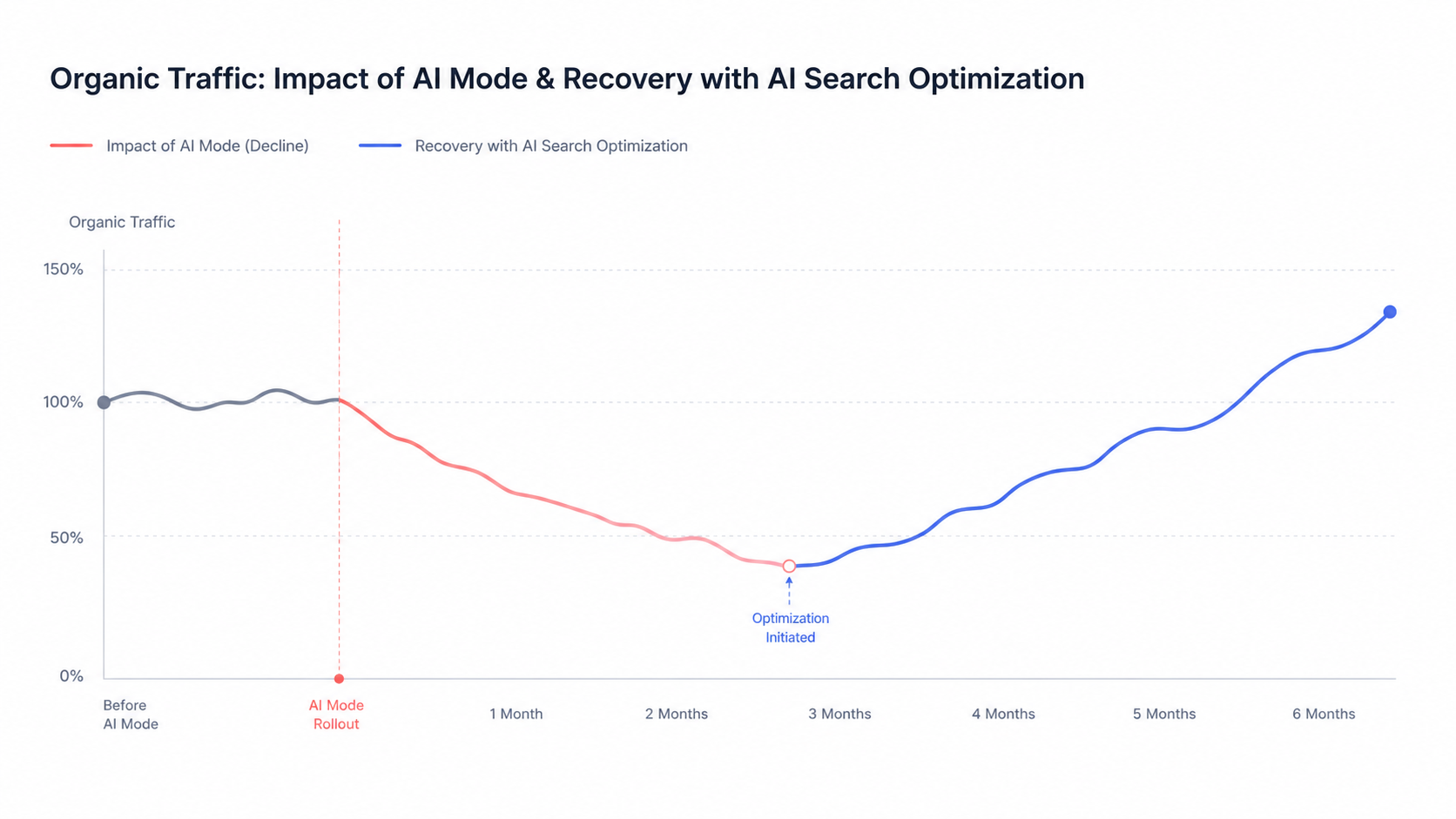
From ten blue links to an assistant: the structural shift Google confirmed at I/O 2026.
What "AI Mode Going Default" Really Means
AI Mode going default means the AI-first, conversational experience is now the standard way people search, not an optional tab they choose. A user can type a question, get an AI Overview, and slide into a back-and-forth AI conversation without ever leaving Google or clicking a website. That flow is now live globally on desktop and mobile.
Here is the important nuance, because the headlines oversold it. Google did not kill the ten blue links. Liz Reid, Google's VP of Search, said plainly from the stage that the new search box does not mean you will only get AI responses. Classic results still exist. But the default path now pulls users deeper into AI from the very first keystroke, and defaults are destiny.
The practical translation for your brand is blunt: ranking number one no longer guarantees you appear in the answer. If Google's AI synthesizes a response and your page is not cited, you are invisible on that query even from position one. This is why we have spent the last year rebuilding client strategies around AI search visibility rather than rankings alone.
The question is no longer "do I rank?" It is "am I in the answer?" Those are different games, and 2026 is the year the second one started to matter more.
The Traffic Reality, By the Numbers
The data on AI search is sobering but not apocalyptic: clicks are being intercepted, not erased, and demand is being redistributed rather than destroyed. Understanding the real numbers helps you respond with strategy instead of panic, so here is what the most rigorous independent research actually shows.
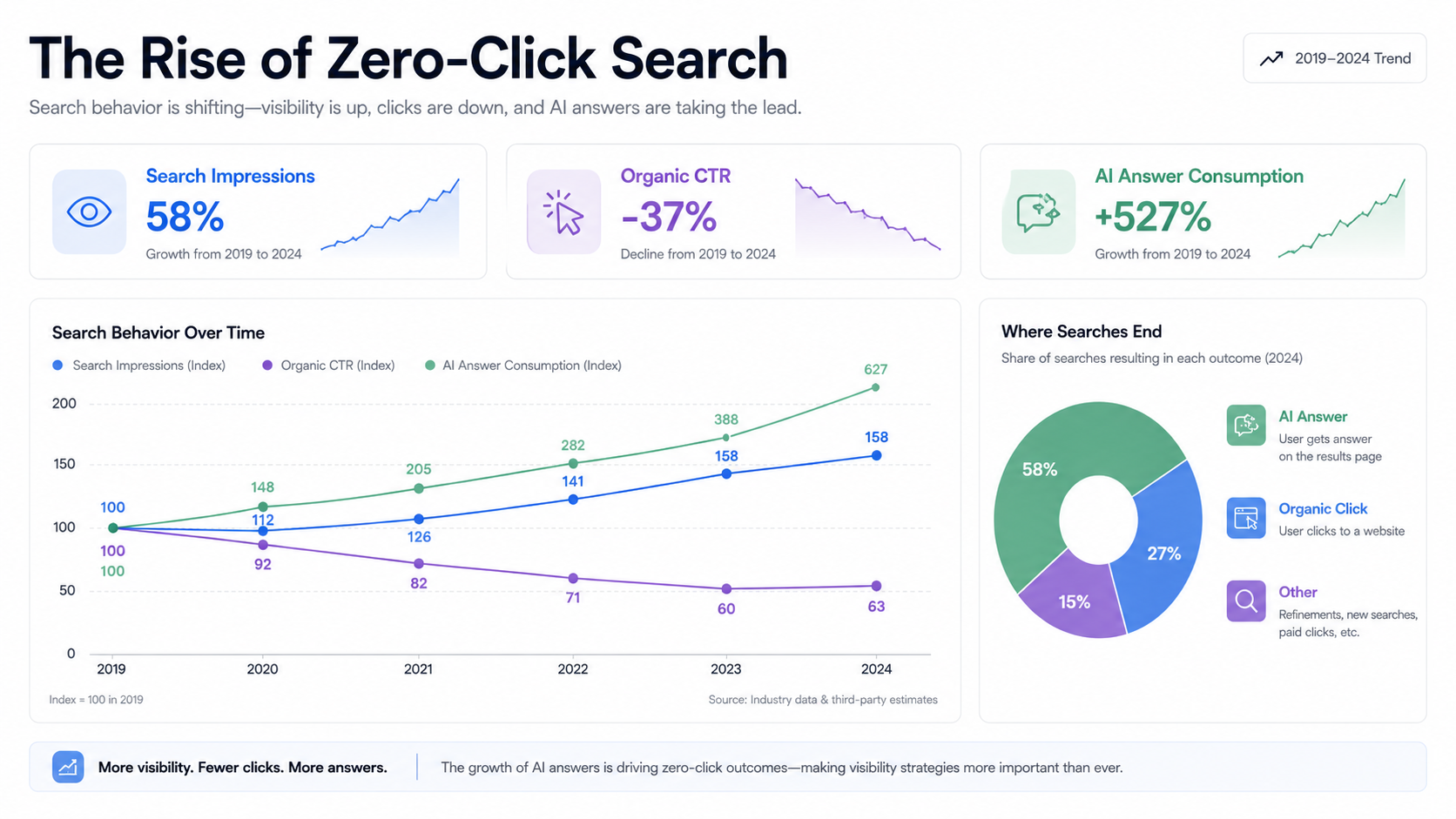
Zero-click search keeps climbing as AI answers more queries directly on the page.
The single most important figure for I/O 2026 is the AI Mode zero-click rate. Because AI Mode replaces organic results with a conversation rather than showing links beside a summary, analysts peg its zero-click rate at roughly 93%. For queries answered in AI Mode, traditional organic SEO has effectively no reach unless your brand is cited inside the AI response itself.
The broader picture is consistent across studies. The Pew Research Center, tracking 68,879 real searches, found people click a result just 8% of the time when an AI summary appears, versus 15% without it, close to a 47% relative drop. A randomized field experiment from the Indian School of Business and Carnegie Mellon measured a 38% decline in outbound clicks on queries where AI Overviews appeared.
| Study / source | Measured impact on clicks |
|---|---|
| Pew Research (68,879 searches) | 8% click rate with AIO vs 15% without (~47% drop) |
| ISB & Carnegie Mellon field experiment | 38% fewer outbound clicks on AIO queries |
| Ahrefs (300,000 keywords) | 34.5% CTR drop for position-1 pages |
| Industry consensus (AI Mode) | ~93% zero-click; organic links replaced entirely |
But notice the other half of the story. Google itself reports search queries hit an all-time high, because people now search more, and longer. Demand is not shrinking; it is moving into surfaces where being cited beats being ranked. That is the opportunity hiding inside the scary headlines, and it rewards brands that adapt their content strategy early.
Why Your Reporting Just Broke
I/O 2026 quietly broke the standard marketing measurement model, because background agents and agentic checkout create outcomes with no session, no UTM parameter, and no trackable click path. When an information agent satisfies a user's intent silently, or Universal Cart completes a purchase inside Google, your analytics never sees the journey.
This is the part most teams have not absorbed yet. If a customer's research and even their purchase can happen without a single visit to your site, then sessions and last-click attribution stop telling the truth. You can influence a sale you can no longer see. Measuring success by raw traffic in this world means measuring the symptom, not the outcome.
Judging SEO mainly through sessions in 2026 will make a healthy brand look like it is failing. Shift your scorecard toward what actually reflects value: branded search demand, AI citations and mentions, assisted conversions, revenue, and share of voice inside AI answers. Clean analytics and event tracking is the foundation that makes this visible.
How to Stay Visible: SEO, AI SEO and GEO
Staying visible after I/O 2026 means optimizing for three layers at once: classic SEO to rank, AI SEO to be understood, and GEO to be cited inside AI answers. They overlap heavily, so the same quality work compounds across all three. Here is how we frame it for clients navigating the shift.
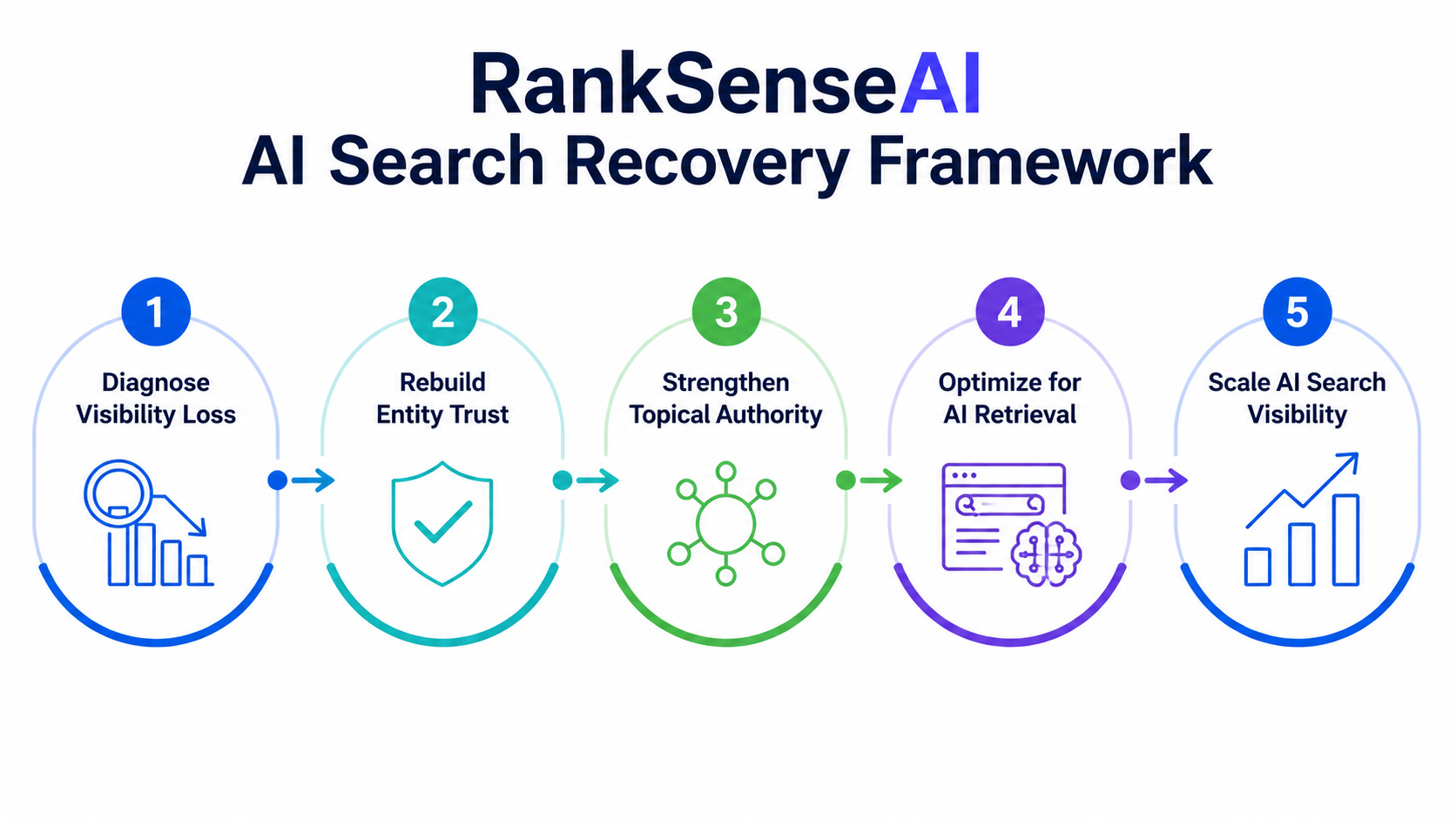
Our framework: rank with SEO, get understood with AI SEO, get cited with GEO.
Layer 1 - Classic SEO still matters. Google's AI pulls from its own index, so technical health, crawlability, and authority remain the entry ticket. If Google cannot crawl and trust you, its AI cannot cite you. Solid technical SEO is now table stakes for AI visibility, not a separate project.
Layer 2 - AI SEO makes you understandable. Structure content so machines can extract it: clear headings that mirror real questions, answer-first paragraphs, schema markup, and entity clarity about who you are and what you do. This is the core of our AI SEO services.
Layer 3 - GEO gets you cited. Generative engine optimization is about earning a place inside the AI answer. Original data, quotable statistics, named frameworks, and strong brand signals are what AI engines reach for. Pair that with digital PR and link building so your authority is visible everywhere AI looks.
- Add answer-first structure to key pages: a 40-60 word direct answer up top.
- Publish original data and named frameworks AI engines want to cite.
- Implement schema so machines understand your content and entities.
- Track AI citations and brand search, not just sessions.
- Build brand authority, the signal both Google and LLMs trust most.
Worried AI Mode is quietly eating your traffic?
Get an independent read on your AI search visibility and a clear next-90-days plan to get cited, not just ranked. No long contracts, no fluff.
Explore AI SEO Services ->Our Honest View, From RankSenseAI
Here is our straight take: I/O 2026 is not the death of SEO, it is the end of lazy SEO. The brands that treated search as a volume game, pumping out thin content to farm clicks, are in real trouble. The brands that built genuine authority and original value are about to pull further ahead, because that is exactly what AI engines cite.
We will be honest about the uncomfortable part. If your traffic depends on informational content that an AI can now answer in two sentences, that traffic is not coming back to its old levels, and pretending otherwise helps no one. But the demand behind it has not vanished. It has moved into AI answers, branded search, and high-intent moments where citation and trust win.
So our advice is neither panic nor denial. It is to adapt deliberately: be the source AI quotes, own your category, and measure what actually drives revenue. We genuinely believe this shift rewards quality more than any update in a decade, and that is the entire thesis behind our SaaS and B2B SEO work. The window to adapt is open now, while most competitors are still arguing about whether SEO is dead.
Frequently Asked Questions
What did Google announce about AI Mode at I/O 2026?
At Google I/O 2026 on May 19, Google made AI Mode the default search experience globally, powered by the new Gemini 3.5 Flash model. It also unveiled a reimagined AI search box, persistent background "information agents," expanded agentic checkout through Universal Cart, and broader personalization. AI Mode had surpassed one billion monthly active users at the time of the announcement.
Is AI Mode now the default on Google Search?
Yes. As of I/O 2026, the AI-first search experience is the global default across desktop and mobile, not an optional tab. Users flow from a query to an AI Overview to a conversational follow-up without leaving Google. However, Google's VP of Search confirmed classic blue-link results still exist; the default simply leads with AI.
Does ranking number one still matter after I/O 2026?
Ranking still matters, but it is no longer enough. With AI Mode as default, Google can answer a query by synthesizing information, and if your page is not cited in that answer, you stay invisible even at position one. The goal has shifted from ranking first to being cited inside the AI response.
How much traffic do websites lose to AI search?
It varies by query type, but the direction is unanimous. Pew Research found clicks fall from 15% to 8% when an AI Overview appears, roughly a 47% relative drop. Inside AI Mode, the zero-click rate reaches about 93% because organic links are replaced by a conversation. Transactional and branded queries retain far more clicks.
What is the difference between SEO, AI SEO, and GEO?
SEO optimizes to rank in traditional search results. AI SEO structures content so AI systems can understand and extract it, using clear answers, schema, and entity clarity. GEO, or generative engine optimization, focuses on earning citations inside AI-generated answers through original data and brand authority. In 2026 you need all three working together.
How do I get my brand cited in Google's AI Mode and AI Overviews?
Lead each section with a direct, quotable answer, support claims with original statistics and data, implement schema markup, and keep authoritative content ungated. Build strong brand and entity signals, since AI engines preferentially cite trusted, recognized sources. Consistent topical authority across a subject is the clearest signal that earns AI citations.
Is SEO dead after Google I/O 2026?
No, SEO is not dead, but it has fundamentally changed. Search demand is at an all-time high; clicks are simply being redistributed toward AI answers and branded queries. SEO is evolving from earning clicks to earning visibility, mentions, and citations across Google, AI Overviews, AI Mode, and tools like ChatGPT and Perplexity.
What should businesses do right now to prepare?
Audit your content for answer-first structure and original value, implement schema, and shift your reporting toward AI citations, branded search, assisted conversions, and revenue rather than raw sessions. Prioritize genuine authority and category ownership. Starting now, while competitors hesitate, is the biggest advantage available in this transition.
Key Takeaways
- At Google I/O 2026, AI Mode became the global default search experience, powered by Gemini 3.5 Flash.
- Google rebuilt the search box for the first time in 25 years and launched 24/7 background search agents.
- Ranking number one no longer guarantees visibility; being cited inside the AI answer is the new goal.
- AI Mode carries a ~93% zero-click rate, and Pew found clicks roughly halve when AI Overviews appear.
- Background agents and agentic checkout break session and last-click measurement; track citations and revenue instead.
- Search demand is at an all-time high; clicks are being redistributed, not destroyed.
- Winning means combining SEO, AI SEO and GEO so you rank, get understood, and get cited.
Get cited, not just ranked
Google I/O 2026 changed the rules. If you want a strategy built for AI Mode, AI Overviews and the answer engines, start with an honest look at where your brand stands today.
Explore RankSenseAI Services ->
Author: Irfan
Irfan Dar is an SEO professional with 4+ years of experience in SEO, performance marketing, and digital analytics. He specializes in technical SEO, content strategy, on-page optimization, keyword research, AEO (Answer Engine Optimization), and GEO (Generative Engine Optimization). At RankSenseAI, Irfan focuses on helping businesses improve their visibility across traditional search engines and emerging AI search platforms. His work covers technical SEO, content optimization, AI search visibility, structured data, entity optimization, and strategies designed to help brands get discovered across search experiences such as Google AI Overviews, ChatGPT, and other AI-powered platforms. He also works with tools and platforms including Google Search Console, GA4, Google Tag Manager, SEMrush, Screaming Frog, Google Ads, Meta Ads, and Looker Studio. Irfan believes effective SEO is not just about rankings. It is about creating useful, technically sound content and building the signals that help search engines and AI systems understand, trust, and surface a brand.