
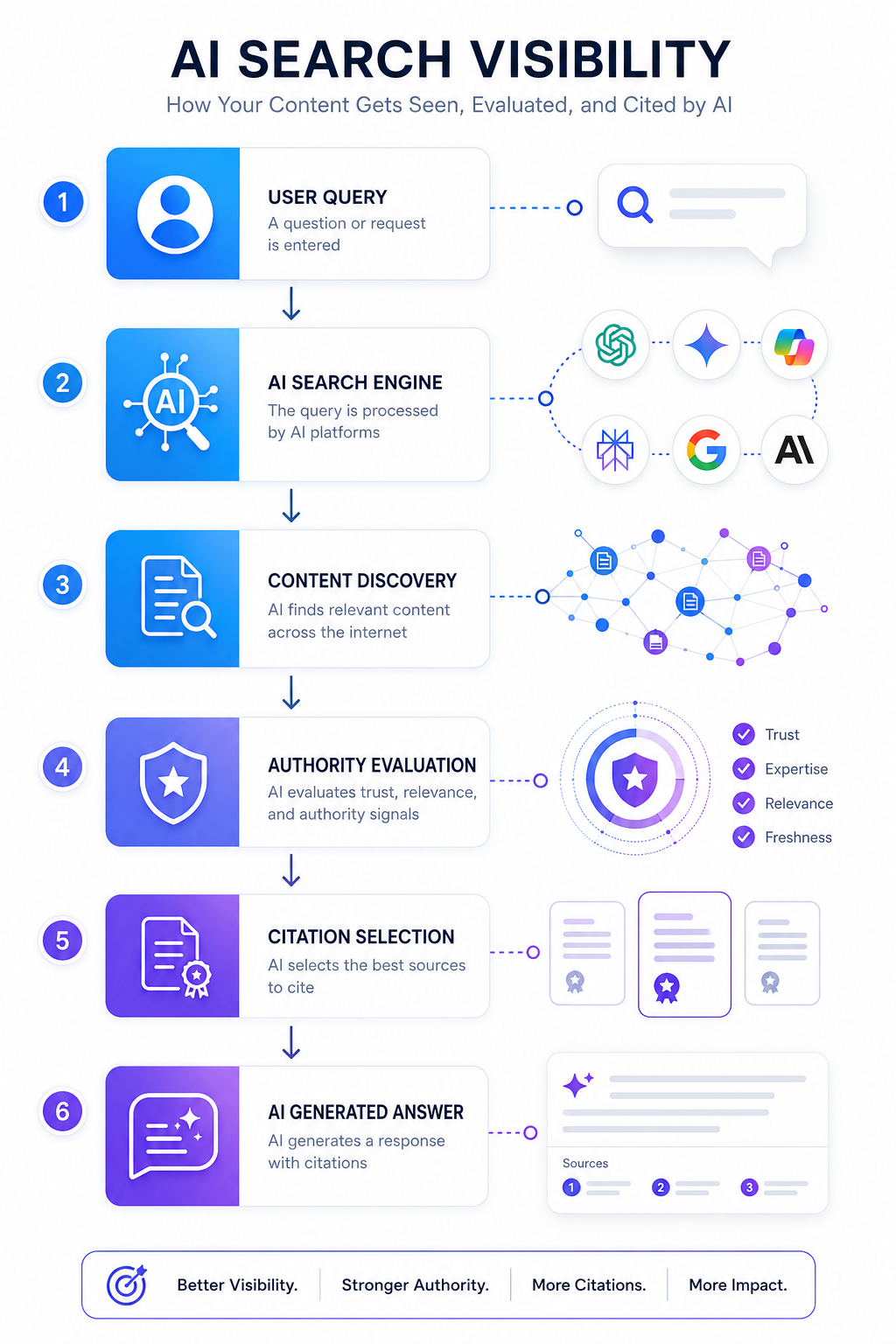
Here's the uncomfortable truth that nobody in your growth team wants to say out loud: your SaaS brand could be ranking #1 on Google and still be completely invisible to the people who matter most.
That's not a hypothetical. It's what's happening right now — quietly, systematically — across thousands of SaaS products as AI-powered search transforms from a novelty into the default way people discover software. When a potential customer asks ChatGPT "what's the best project management tool for remote teams?" or Perplexity "compare Notion vs Linear for product teams," they're not seeing a ranked list of blue links. They're getting a synthesized answer. And if your brand isn't in that answer, you simply don't exist for that query.
The challenge? Most SaaS teams have no idea where they stand. They're still staring at position-tracking dashboards and organic traffic charts — metrics that were built for a different era of search. They're measuring the wrong game.
This guide is the fix. We're going to walk you through exactly how to measure your AI search visibility — step by step — so you know where you stand, what you're missing, and what to do about it.
Why AI Search Visibility Is the New Battleground for SaaS
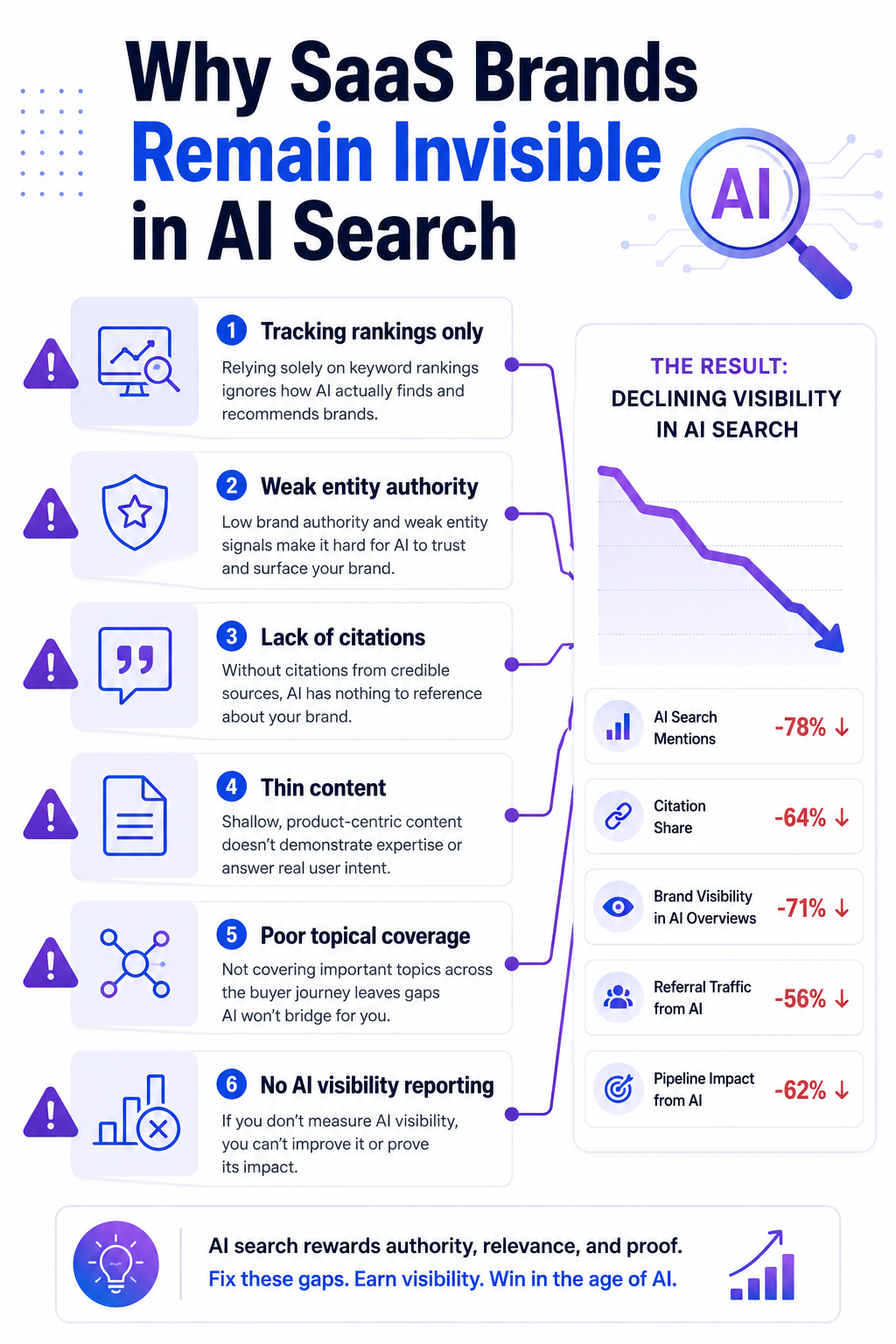
The shift from rank-based to citation-based visibility is already here — and SaaS brands are the most exposed.
Let's put some numbers on the scale of this shift before we get into the how-to, because the data is genuinely staggering.
That 93% zero-click stat deserves a moment of silence. When AI Mode handles a query — which is increasingly the default path for software-related searches — traditional organic links are functionally invisible. The only brands that exist in that interaction are the ones being cited inside the AI's synthesized answer.
SaaS is uniquely vulnerable here for two reasons. First, software buyers are exactly the kind of high-intent, conversational searchers who gravitate toward AI tools. They ask complex, specific questions — "what's the best CRM for a 50-person B2B SaaS team that integrates with HubSpot" — that AI engines are built to handle. Second, the SaaS comparison and research phase happens entirely in search, which means the brand that gets cited in the AI answer often shapes the buyer's consideration set before they ever visit a website.
This is why our entire approach to SaaS SEO at RankSenseAI has shifted toward what we call a three-layer model: traditional SEO to stay in Google's index, AI SEO to be understood by AI engines, and GEO (Generative Engine Optimization) to actually get cited inside answers. Measuring AI search visibility is where that journey begins.
Step 1: Set Your AI Visibility Baseline (The Reality Check)
Before you optimize anything, you need to know where you actually stand.
Most SaaS teams skip this step and go straight to content production. That's like launching a paid campaign without tracking conversions — you're spending energy with no feedback loop. Your AI visibility baseline is the foundation everything else is built on.
The Manual Audit: Start Here (Free, Takes 2 Hours)
Before you invest in any specialized tools, do this manually. It's free, it's fast, and the qualitative insights you get are things no tool will surface for you.
Open fresh, logged-out sessions on ChatGPT, Perplexity, Google AI Overviews, and Google AI Mode. For each platform, ask 15–20 queries that a real prospect in your category would ask. Vary the intent:
- Awareness queries: "What tools help SaaS teams with [your core use case]?"
- Comparison queries: "[Your brand] vs [Competitor 1] vs [Competitor 2]"
- Problem queries: "How do I solve [specific pain point your product addresses]?"
- Best-of queries: "Best [your category] software for [your ICP]"
- Brand queries: "[Your brand name]" — what does the AI say about you directly?
For each query, record: Is your brand mentioned? What position in the answer (first, middle, last)? Is it a citation with a link, a bare mention, or an implicit recommendation? What language does the AI use to describe you? Are you described accurately?
🎯 Your Baseline Scorecard
Track these four numbers from your manual audit. They're your starting point for everything that follows:
Prioritize Your Query Universe
You can't monitor every possible AI query — nor should you. The 80/20 applies hard here. For your baseline audit, prioritize:
- Your highest-revenue keyword clusters from traditional SEO research
- Queries where competitors consistently appear (you're losing the citation game)
- Bottom-of-funnel queries with clear buying intent — "best [category] for [ICP]"
- Your brand name in direct and comparison contexts
If you already work with our SEO audit team, your keyword universe from that audit is the perfect starting point for your AI visibility baseline. The same queries that matter for traditional rankings matter enormously for AI citation research.
Step 2: Identify the Right AI Search Signals to Track
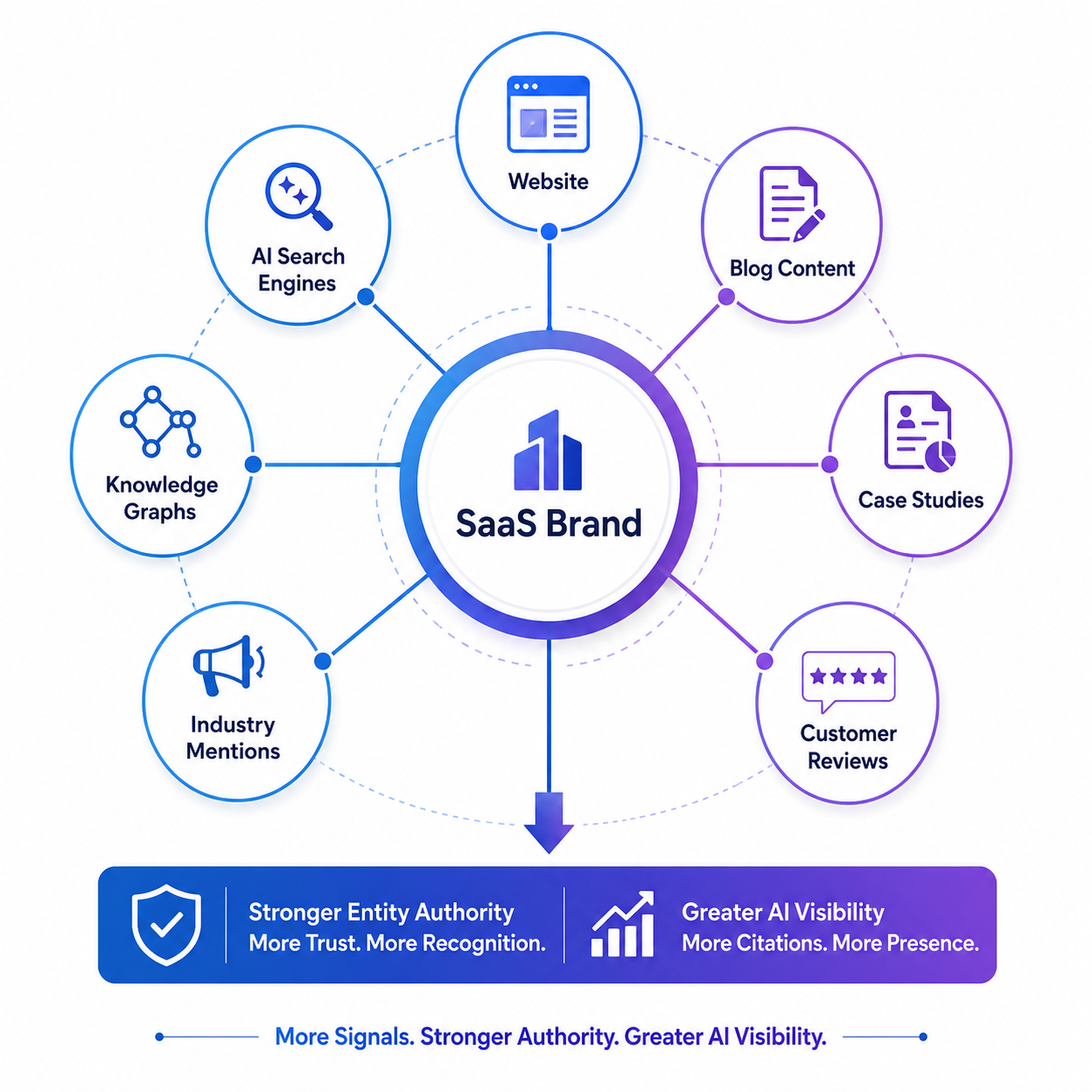
Not all signals are created equal. Here's what actually moves the needle for SaaS AI visibility.
The signals that prove AI search visibility — and the vanity metrics to ignore.
There's a real danger in this space: measuring things that look like AI visibility but don't actually correlate with business outcomes. Before you build a dashboard, you need to agree on which signals actually matter.
Primary Signals (Measure These Every Month)
| Signal | What It Measures | Why It Matters for SaaS | How to Get It |
|---|---|---|---|
| AI Citation Rate | % of target queries where brand is mentioned in AI answer | Direct proxy for top-of-funnel AI presence | Manual audit + GEO tools |
| Branded Search Volume | Monthly search volume for your brand name | Rising branded search = AI is driving awareness → curiosity | Google Search Console |
| AI Referral Traffic | Sessions from ChatGPT, Perplexity, Claude etc. | Direct traffic signal from AI-cited links | GA4 + UTM tracking |
| AI Share of Voice | Your citation rate vs. competitors across shared queries | Relative competitive position in AI answers | Competitive audit tools |
| AI Source Authority | Which domains the AI cites when citing you | Helps identify which third-party mentions amplify you | Citation analysis in GEO tools |
Secondary Signals (Watch These Quarterly)
- Dark social / direct traffic trends — AI-influenced research that results in a direct URL visit, not trackable via last-click
- Sign-up source survey data — "How did you first hear about us?" — AI mentions in responses are rising signals
- Review site presence — G2, Capterra, and Trustpilot are heavily cited by AI engines; your review velocity matters
- Third-party mention velocity — How often are industry blogs, newsletters, and publications mentioning your brand?
Signals to Ignore (They'll Mislead You)
- Raw organic sessions alone — Traffic can fall while AI visibility (and pipeline) rises. They're decoupling.
- AI Overview impressions in GSC without click data — Impressions without citations are noise
- Generic "AI traffic" without platform segmentation — ChatGPT referrals and Google AI Mode are fundamentally different surfaces
- Keyword rankings as a proxy for AI visibility — A page can rank #1 and never get cited in AI answers
Getting signal mapping right is exactly what separates brands that improve their AI visibility methodically from those who churn out content and hope for the best. Our content strategy team spends significant time on this mapping before any content work begins.
Step 3: Select Your AI Visibility Measurement Tools
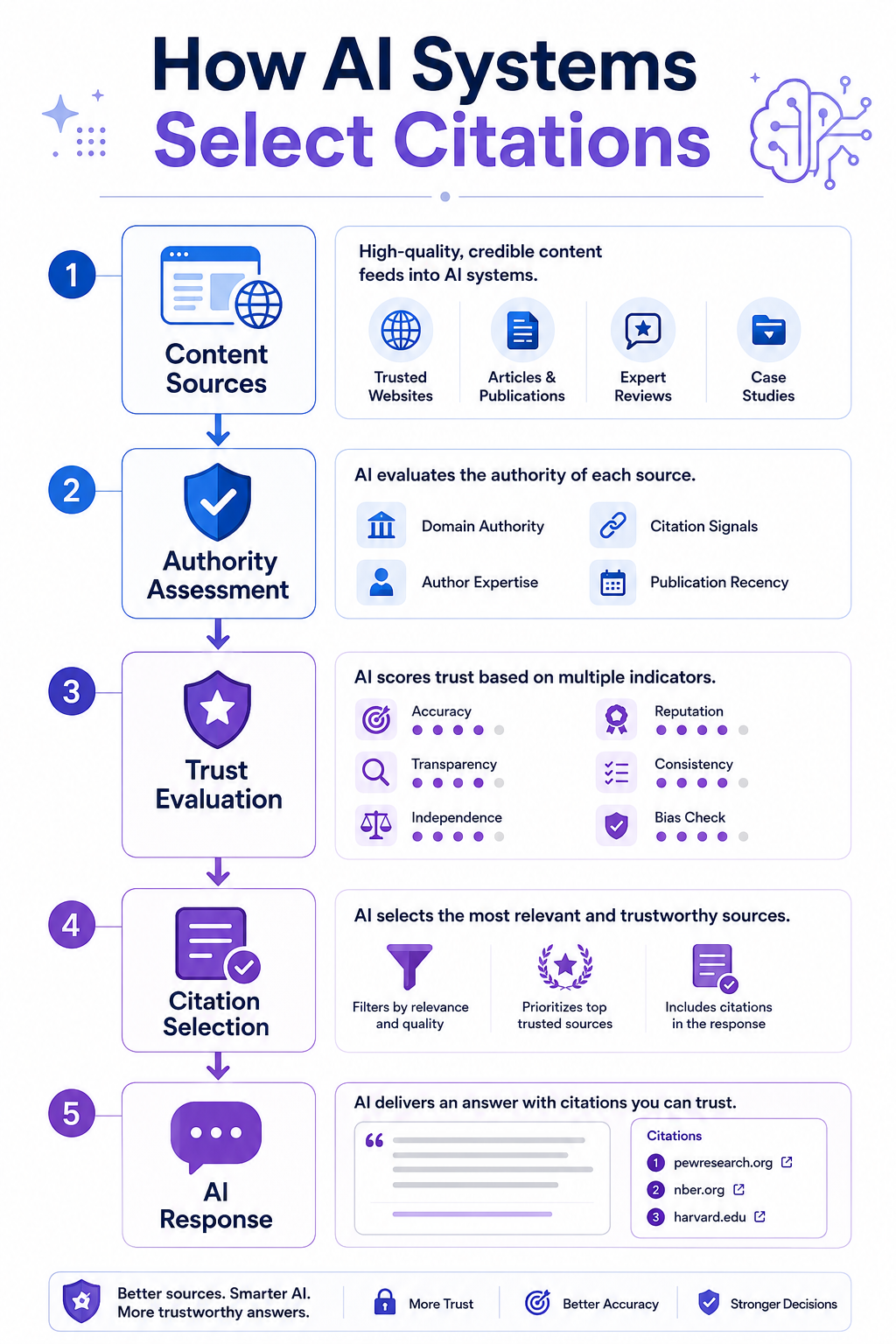
The right tools make AI visibility tracking systematic. Here's what's actually worth your budget.
There is no single perfect tool — yet. Here's the stack that works.
The GEO measurement tooling landscape is evolving fast. Some tools launched in 2024 already feel dated. What we've found, working with SaaS brands across multiple categories, is that the best approach combines a few specialized tools with some manual methodology you'll do yourself.
The AI Visibility Tool Stack (2026)
Purpose-built for tracking brand mentions across AI engines at scale. Best for SaaS brands with 50+ target queries. Expensive but the most comprehensive.
More accessible price point than Profound. Good for mid-market SaaS teams. Tracks ChatGPT, Perplexity, and Gemini mentions over time.
If you're already on Semrush, their AI Overview tracking features let you layer AI visibility on top of existing keyword data without a separate tool subscription.
Excellent for tracking third-party mentions across web content that AI engines pull from — the upstream visibility that leads to downstream citations.
The branded search trend data in GSC is your best free signal for AI-driven awareness. Watch for rising branded impressions and queries without clicks.
Segment by referring domain to catch ChatGPT, Perplexity, Claude, and Gemini referral traffic. Set up as a custom channel group inside GA4.
Dedicate 2 hours per month to manually testing your top 20 queries across AI platforms in incognito mode. No tool replaces the qualitative insight this provides.
Free proxy for AI awareness impact. Compare branded search velocity against competitors. Rising share correlates with AI citation growth over 3-6 months.
Setting Up GA4 for AI Referral Tracking
This is something every SaaS team should do today, regardless of where they are in their GEO journey. In GA4, create a custom channel group that captures AI referral traffic:
- Create a custom "AI Referrals" channel in GA4 → Admin → Channel Groups
- Add rules to catch:
chat.openai.com,perplexity.ai,claude.ai,gemini.google.com - Track session quality, conversion rate, and pages visited from this channel separately
- Note: AI Mode visits from Google itself will often appear as organic or direct — not solvable yet
If you're not confident your current Google Tag Manager setup is tracking cleanly, now is an excellent time to audit that foundation. Garbage in, garbage out — especially for a new tracking category like AI referrals.
Step 4: Build Your AI Search Visibility Dashboard
Your AI visibility dashboard should tell a story — not just show numbers.
The worst dashboards we see are the ones that dump every available metric into a spreadsheet. The best ones are designed around a single question: "Is our AI search visibility improving, staying flat, or declining — and why?"
The 5-Section AI Visibility Dashboard Structure
| Dashboard Section | Key Metrics | Data Source | Cadence |
|---|---|---|---|
| 1. AI Citation Overview | Overall citation rate, citations by platform (ChatGPT / Perplexity / Google AIO / AI Mode) | Manual audit + GEO tool | Monthly |
| 2. AI Share of Voice | Your citation rate vs. top 3 competitors across shared query set | Competitive GEO audit | Monthly |
| 3. Branded Search Trends | Branded impressions, branded queries, brand YoY growth | Google Search Console | Weekly |
| 4. AI Referral Traffic | Sessions, conversion rate, and revenue from AI-referred visitors | GA4 custom channel | Weekly |
| 5. Content Citation Analysis | Which pages / content types are generating AI citations | GEO tool + manual | Monthly |
Dashboard Best Practices
- Always show the trend, not just the number. A 34% citation rate means nothing without knowing if it was 28% last month or 42%. Direction is the signal.
- Segment by query intent. Your citation rate on awareness queries vs. comparison queries vs. purchase-intent queries will be radically different — and each has different optimization levers.
- Connect upstream to downstream. Build a view that links AI citation trends → branded search trends → AI referral traffic → conversions. The lag between layers is typically 4–12 weeks.
- Include a "worst performing queries" view. The queries where competitors appear and you don't are your highest-value optimization targets.
- Review quarterly with leadership. This is not a data team report — it's a strategic discussion. Bring it to your growth or marketing leadership meeting with context, not just numbers.
Step 5: Run a Competitive AI Visibility Gap Analysis
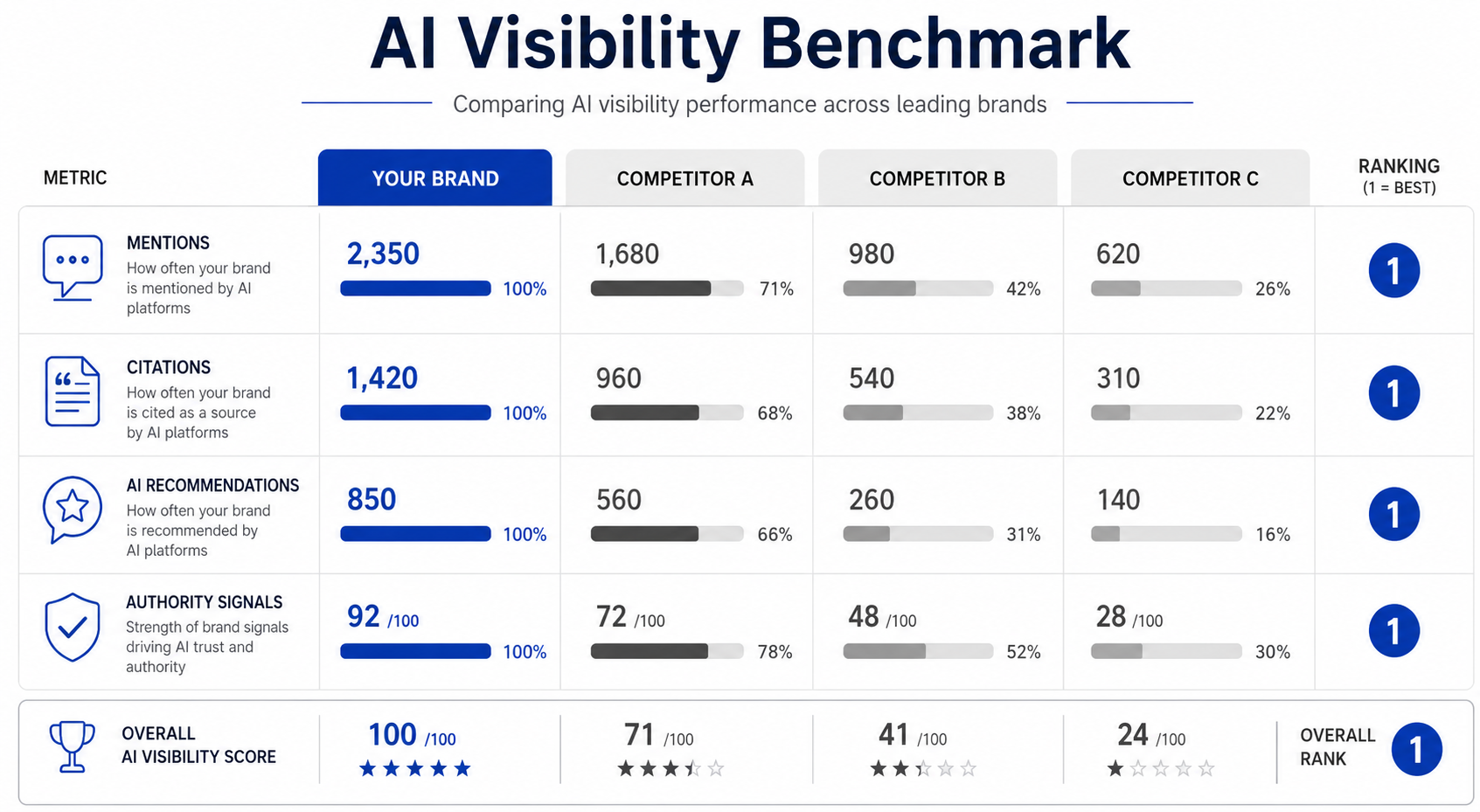
Knowing where competitors appear that you don't is the fastest way to find your highest-value optimization targets.
You don't need to win everywhere. You need to win where it counts most.
Competitive AI visibility analysis is where measurement becomes strategy. When you understand which queries your competitors dominate in AI answers — and why — you get a direct blueprint for where to focus your content and authority-building efforts.
How to Run an AI Competitive Gap Analysis
Phase 1: Map the competitive query landscape. Take your 20–40 highest-priority queries. For each one, run it across ChatGPT, Perplexity, and Google AI Mode. For every result, record every brand cited — not just whether you appear. Build a citation frequency table:
| Query | Platform | Brands Cited | Your Brand? | Your Position |
|---|---|---|---|---|
| "Best project mgmt for SaaS" | ChatGPT | Notion, Linear, Asana, ClickUp | ❌ No | — |
| "Notion vs Linear for product teams" | Perplexity | Notion, Linear, [Your Brand] | ✅ Yes | #3 |
| "How to manage OKRs for SaaS startup" | Google AI Mode | Lattice, Leapsome, Ally.io | ❌ No | — |
Phase 2: Identify the patterns behind competitor citations. For every competitor that consistently appears where you don't, ask: What content do they have that you don't? Do they have stronger third-party citations (reviews, press, analyst coverage)? Are they using schema markup or structured data more effectively? Do they have original research or data that AI engines keep citing?
Phase 3: Prioritize your gap-closing initiatives. Not all gaps are equal. Focus first on:
- High-intent queries (comparison / best-of) where you're absent but competitors appear — these drive the most direct pipeline impact
- Queries where you appear but in position 4–6 — easier to move to position 1–2 than to enter from zero
- Queries where AI descriptions of you are inaccurate or incomplete — an accuracy problem, not just a visibility problem
Step 6: Improve Your AI Citation Rate — Iterating on Data
Measurement without action is just expensive information. Here's what actually moves the needle.
Once you have a baseline, a dashboard, and a competitive gap analysis, the question becomes: what do you actually do to improve? Here are the highest-leverage actions we've seen work consistently across SaaS categories.
Content Optimization Actions That Drive AI Citations
- Add a direct-answer paragraph to every key page. 40–60 words that directly answer the query the page targets. Lead with the answer, then elaborate. AI engines love to lift these verbatim as citation snippets.
- Create original data and named frameworks. The single most powerful thing you can do. AI engines cite original research far more than generic how-to content. A survey of 200 SaaS operators, a proprietary benchmark, a named methodology — these become citation magnets. Our SEO content team builds these into every content strategy we create.
- Implement schema markup systematically. Article, HowTo, FAQPage, Product, and Organization schema help AI engines understand what your content is and who your brand is. Technical SEO work is now directly upstream of GEO performance.
- Build third-party citation authority. AI engines pull from the web, and the sites they trust most are high-DR review platforms, industry publications, and analyst sites. Aggressively pursue G2 and Capterra reviews. Earn coverage in newsletters and SaaS industry blogs. Strategic link building that earns mentions on authoritative pages directly boosts AI citation probability.
- Fix accuracy issues immediately. If AI is describing your product inaccurately (wrong features, wrong pricing, wrong category), this is an emergency, not a nice-to-have. Update your own site's structured data, reach out to major review platforms, and consider targeted digital PR to reset the narrative.
- Create AI-native comparison content. "X vs Y" and "best tools for [use case]" pages are among the most-cited content types in AI answers. Build them with clear, structured comparisons, updated pricing, and honest pros/cons — the kind of content AI engines trust enough to summarize.
The Optimization → Measurement Loop
The most important thing to understand about improving AI visibility is that the feedback loop is slower than traditional SEO. A change you make today — a new piece of content, a new schema implementation, a new batch of G2 reviews — might not show up in your AI citation metrics for 4–8 weeks. That's not a bug; it's the nature of how AI models are updated and how web crawlers index new signals.
This means you need to run parallel tracks: measuring monthly while optimizing continuously without waiting for the data to confirm every individual action. Build your editorial calendar around what the data tells you quarterly, not weekly.
📅 Your Monthly AI Visibility Rhythm
- Week 1: Run your monthly AI citation audit. Update your dashboard. Note biggest changes vs. prior month.
- Week 2: Competitive gap review. Identify top 3 "not cited here but competitors are" opportunities this month.
- Week 3: Execute content and technical actions from prior month's analysis. Brief content team on new priorities.
- Week 4: Track AI referral traffic and branded search trends. Flag any anomalies for leadership.
This entire measurement and optimization loop is what we build for SaaS clients through our AI SEO services. If you're doing this in-house and need to upskill your team, our SaaS SEO training and AI SEO training programs are built specifically to bridge this knowledge gap.
Not Sure Where Your SaaS Brand Stands in AI Search?
We run AI search visibility audits for SaaS brands — and we'll show you exactly where you're being cited, where you're invisible, and the fastest path to fixing it.
Get Your AI Visibility Audit →The GEO vs. Traditional SEO Distinction — And Why It Changes Your Strategy
We've been using the term GEO (Generative Engine Optimization) throughout this guide, and it's worth pausing to be precise about what it means and how it differs from what you already do.
Traditional SEO is about ranking — getting your pages to position 1–10 in a list of results. Success is measured by position, impressions, and clicks. The optimization levers are technical health, on-page signals, and backlink authority.
AI SEO is about being understood — structuring your content and entities so AI models can accurately comprehend what you do, who you serve, and why you're authoritative. Success is measured by how accurately AI engines describe you.
GEO is about being cited — earning a spot inside the synthesized answer that AI engines produce. Success is measured by citation rate, citation position, and the downstream brand signals that citations drive.
The three layers are interdependent. You can't be cited by AI engines (GEO) if they don't understand you (AI SEO), and they can't understand you if they can't crawl and trust you (traditional SEO). This is why our growth SEO approach treats them as a unified strategy, not three separate workstreams.
If you're a B2B SaaS brand with a longer sales cycle and an enterprise buyer, the stakes are especially high. Enterprise buyers are increasingly using AI tools for vendor research before they ever engage with sales. Our B2B SEO services are built around this reality — because the brand that gets cited in the research phase often shapes the shortlist before a single demo is booked.
E-E-A-T and AI Visibility: The Connection SaaS Brands Miss
Google's E-E-A-T framework — Experience, Expertise, Authoritativeness, and Trustworthiness — was designed for traditional search quality evaluation. But it's become directly relevant to AI visibility in a way that most SaaS content teams haven't fully absorbed.
AI engines — especially Google's AI Overviews and AI Mode — are trained to prioritize sources that signal genuine authority. Not optimized content. Not "AI-friendly" formatting tricks. Actual domain authority, author credentials, original data, and corroboration from third-party sources. That's E-E-A-T in practice.
- Experience: Show that your product has been used by real companies solving real problems. Case studies, testimonials, and user-generated content signal this. AI engines are increasingly good at distinguishing "thought leadership about a topic" from "proven experience with the topic."
- Expertise: Your authors matter. If your content is written by an anonymous "team" with no credentials, it carries less weight than content with a named, credentialed expert author. Add author schema to every article. Link author profiles to LinkedIn and published work.
- Authoritativeness: This is primarily about who else cites you. Backlinks remain a signal. But so are podcast appearances, quoted commentary in industry press, G2 award badges, and analyst reports that reference your product.
- Trustworthiness: Accuracy is table stakes. But so is transparency. Publish your methodology when you release data. Show your sources. Be honest about limitations and tradeoffs. AI engines are better than you think at detecting confidence calibration.
We build E-E-A-T signals into every piece of content and every technical recommendation we make for SaaS SEO clients. It's not a separate checklist — it's a philosophy that shapes how we approach authority building across the board.
Frequently Asked Questions
The Bottom Line: Measurement Is the Competitive Advantage
Here's what we know from working with SaaS brands across competitive categories: the teams that win in AI search aren't the ones with the biggest content budgets. They're the ones with the best feedback loops.
Right now, the vast majority of your competitors are not measuring AI search visibility systematically. They're not running monthly citation audits. They're not tracking AI referral traffic segments. They're not doing competitive gap analyses across ChatGPT, Perplexity, and Google AI Mode. That's your window — and it's open right now.
The brands that build the measurement infrastructure today — the baselines, the dashboards, the competitive tracking — will be the ones with the data to optimize confidently in 12 months when this is mainstream. The brands that wait will be playing catch-up on a moving target.
Start with the manual baseline audit. Two hours. Incognito browser. Your top 20 queries. Write down what you find. That's your foundation. Everything in this guide — the signals, the tools, the dashboard, the gap analysis, the optimization loop — builds from that first honest look at where you actually stand.
If you want to do it faster, with a team that's done it dozens of times across SaaS categories, our AI visibility audit is the starting point. We'll show you exactly where you are, where your competitors are ahead of you, and the specific content and technical actions that will move your citation rate in the next 90 days.
Ready to Make AI Search Work for Your SaaS Brand?
Don't guess at your AI visibility. Get a data-driven audit that shows you exactly where you stand — and what to do next.
Book a Free Strategy Call →